
Understanding the biology of hair loss changes how you evaluate treatments. Most marketing either oversimplifies the mechanism or ignores it entirely. Here's what the peer-reviewed research actually shows about why hair falls out and what interventions can do about it.
The DHT Mechanism
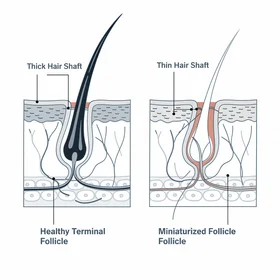
Androgenetic alopecia — the medical term for pattern hair loss — is driven by dihydrotestosterone (DHT), a potent androgen derived from testosterone. The enzyme 5-alpha reductase converts circulating testosterone into DHT. In genetically susceptible follicles, DHT binds to androgen receptors and triggers a process called follicle miniaturization: over successive growth cycles, the follicle produces thinner, shorter, less pigmented hairs until it eventually stops producing visible hair altogether (Kaufman, K.D., Journal of the American Academy of Dermatology, 2002).
The key insight is that DHT does not kill follicles outright. It shrinks them gradually over years or decades. This is why early intervention consistently produces better outcomes — the follicle is easier to rescue when it is miniaturized but still active than after it has gone fully dormant.
Why Genetics Matter More Than Testosterone Levels
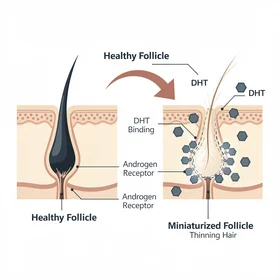
A common misconception is that men with more testosterone lose more hair. The research does not support this. What varies between individuals is not DHT levels but follicle sensitivity to DHT — determined by the density and responsiveness of androgen receptors in scalp follicles. Two men with identical testosterone levels can have completely different hair loss trajectories based on their inherited receptor sensitivity (Ellis et al., European Journal of Dermatology, 2001).
This receptor sensitivity is polygenic — influenced by multiple genes inherited from both parents (not just the maternal grandfather, as the popular myth suggests). The androgen receptor gene on the X chromosome is one factor, but genome-wide association studies have identified over 250 genetic loci associated with pattern hair loss (Hagenaars et al., PLOS Genetics, 2017).
The Hair Growth Cycle
Each hair follicle cycles through three phases independently:
In androgenetic alopecia, DHT progressively shortens the anagen phase while the telogen phase remains constant. The result: hairs spend less time growing and more time resting, producing shorter and finer strands with each cycle. This is why early-stage hair loss often looks like "thinning" rather than outright baldness — the hairs are still there, just smaller.
How Treatments Target the Mechanism
5-Alpha Reductase Inhibitors
Finasteride blocks the Type II 5-alpha reductase enzyme, reducing scalp DHT levels by approximately 60–70%. Dutasteride blocks both Type I and Type II, reducing DHT by over 90%. Clinical trials demonstrate that lowering DHT halts miniaturization in most men and allows partially miniaturized follicles to recover, producing thicker hairs in subsequent growth cycles (Olsen et al., Journal of the American Academy of Dermatology, 2006).
Natural DHT Management
Several botanical compounds have demonstrated 5-alpha reductase inhibition in vitro and in small clinical trials. Saw palmetto extract is the most studied, with a meta-analysis showing it improved hair density in approximately 60% of participants — less potent than finasteride but with a significantly lower side effect profile (Rossi et al., Journal of Cutaneous and Aesthetic Surgery, 2012). Procerin's formulation combines saw palmetto with other natural DHT-management ingredients including beta-sitosterol and nettle root extract, and its IRB-approved clinical study demonstrated statistically significant improvement versus placebo.
Vasodilators
Minoxidil does not affect DHT. Its mechanism is different: it extends the anagen (growth) phase by improving blood flow to the follicle and upregulating vascular endothelial growth factor (VEGF). This is why minoxidil and DHT blockers are often recommended together — they address hair loss through complementary mechanisms (Messenger & Rundegren, British Journal of Dermatology, 2004).
Emerging Research
Several newer approaches are under investigation:
- Platelet-rich plasma (PRP): Concentrated growth factors from your own blood injected into the scalp. Early studies show promise for density improvement, but protocols vary widely and long-term data is limited (Gentile et al., Stem Cells Translational Medicine, 2015).
- Low-level laser therapy (LLLT): FDA-cleared devices that stimulate follicle metabolism. Evidence supports modest improvement, particularly as an adjunct to other treatments (Jimenez et al., American Journal of Clinical Dermatology, 2014).
- JAK inhibitors: Originally developed for alopecia areata (autoimmune hair loss), these are being investigated for androgenetic alopecia with preliminary results. Not yet approved for pattern hair loss.
What the Science Tells Us About Expectations
The research is clear on several points that user opinions consistently confirm:
- Earlier is better. Partially miniaturized follicles can recover; fully dormant ones generally cannot. Starting treatment at Norwood II–III produces measurably better outcomes than starting at Norwood V+.
- Consistency matters more than product choice. Any evidence-based treatment used consistently for 6+ months outperforms treatment-hopping every few weeks.
- Combination approaches outperform monotherapy. DHT reduction + growth stimulation addresses two different mechanisms simultaneously.
- No treatment is a cure. All current treatments manage hair loss — they do not permanently reverse the underlying genetic susceptibility. Discontinuation leads to resumed progression within 6–12 months.
- Individual variation is real. The same treatment produces different outcomes in different people due to genetic receptor sensitivity, stage of loss, and adherence.
Understanding these realities is the best foundation for choosing a treatment and setting expectations that match what the evidence supports — not what marketing promises. For specific user experiences, see what Procerin users report.